Welcome!
My research interests are motivated by geometry, a branch of mathematics that originated in the study of objects in the physical world through their shape, size, and relative position. Geometric objects often become more amenable to analysis when they exhibit symmetry. For example, one can derive far more precise conclusions about an isosceles or an equilateral triangle than about an arbitrary triangle. Such observations illustrate a central theme in geometry: symmetry reveals structure and helps uncover deeper mathematical properties.
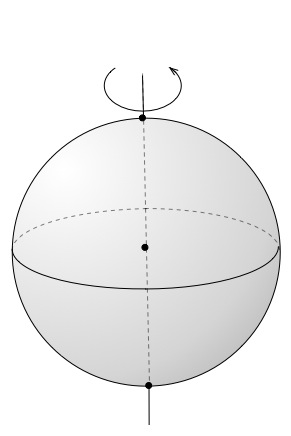
A sphere is a highly symmetric geometric object. For example, imagine the sphere shown in the diagram rotating about one of its diameters. As it turns, its appearance remains unchanged. In modern mathematical language, we express this by saying that the circle group acts on the sphere.
Differentiable manifolds provide mathematical models for spaces of dimension two, three, or even higher. Their symmetries are described by differentiable actions of groups on manifolds. A central question in this context is how the presence of symmetry influences the shape and structure of a manifold. This question can be investigated at various levels of detail, depending on the type of information one wishes to recover. At the most basic level, one may be interested only in topological properties. At a finer level, one may seek to understand how symmetry interacts with additional geometric structures, such as Riemannian or symplectic structures. [For more technical details follow the research link above or click here .]

Teaching
STAT 100 Introduction à la statistique MATH 101 Mathématiques discrètes MATH 231 Euclidean GeometryMATH 335 Introduction to Differential Geometry
MATH 401 Matrix Lie Groups
(see more here )